
Persistent exhaustion that sleep doesn’t fix is one of the most frustrating experiences a person can face. Chronic fatigue and nutrient deficiencies are frequently discussed together, and for good reason. Low iron, vitamin B12, vitamin D, and magnesium can all impair the body’s ability to produce energy at a cellular level. But here’s what most articles skip: nutrient deficiencies are rarely the whole story. They are one piece of a complex puzzle that often includes inflammation, hormonal shifts, infections, and genetics. This article unpacks what the evidence actually says, which deficiencies matter most, and what realistic recovery looks like.
Table of Contents
Key takeaways
| Point | Details |
|---|---|
| Deficiencies are one piece | Nutrient gaps contribute to fatigue but rarely explain it entirely on their own. |
| Iron without anaemia still matters | Low ferritin without full anaemia can cause significant fatigue and is frequently missed on standard testing. |
| Treatment timelines vary | Correcting iron deficiency takes months, not days; B12 symptoms may improve within 48–72 hours of injections. |
| Testing must be specific | Full iron studies, ferritin, B12, and vitamin D panels give a far clearer picture than a basic blood count alone. |
| Root cause matters most | Supplementing without finding why you are deficient often leads to recurring fatigue. |
How nutrient deficiencies drive chronic fatigue
Every cell in your body relies on a steady supply of micronutrients to generate energy. When key nutrients fall short, the machinery that converts food into usable fuel starts to break down. Understanding this process helps explain why the impact of nutrition on fatigue is so significant and why simply eating more does not always solve the problem.
Here is how specific nutrients are involved:
-
Iron carries oxygen in red blood cells via haemoglobin. Without adequate iron, less oxygen reaches muscles and organs, leaving you feeling breathless and drained even during light activity.
-
Vitamin B12 is required for red blood cell formation and the health of the nervous system. Deficiency disrupts both oxygen delivery and nerve signalling, producing fatigue alongside brain fog and tingling sensations.
-
Vitamin D plays a role in mitochondrial function and muscle contraction. Low levels are consistently associated with muscle weakness, generalised fatigue, and low mood.
-
Magnesium is a cofactor in over 300 enzymatic reactions, including those involved in ATP (cellular energy) production. Depletion is common in people under chronic stress and is often overlooked.
-
Folate and zinc support DNA synthesis and immune function. Their deficiency can compound fatigue, particularly in people with poor dietary variety or absorption issues.
The physiological chain is clear. When these nutrients are depleted, cellular energy production slows, and the result is fatigue that feels disproportionate to your activity level. What makes this tricky is that the symptoms of each deficiency overlap significantly, making self-diagnosis unreliable.
The chronic fatigue nutrient deficiencies list: what to know
Recognising the clinical features of each deficiency helps you have a more informed conversation with your doctor. The table below summarises the most common nutrient deficiencies linked to fatigue, their key symptoms, and who is most at risk.
| Nutrient | Key fatigue symptoms | High-risk groups |
|---|---|---|
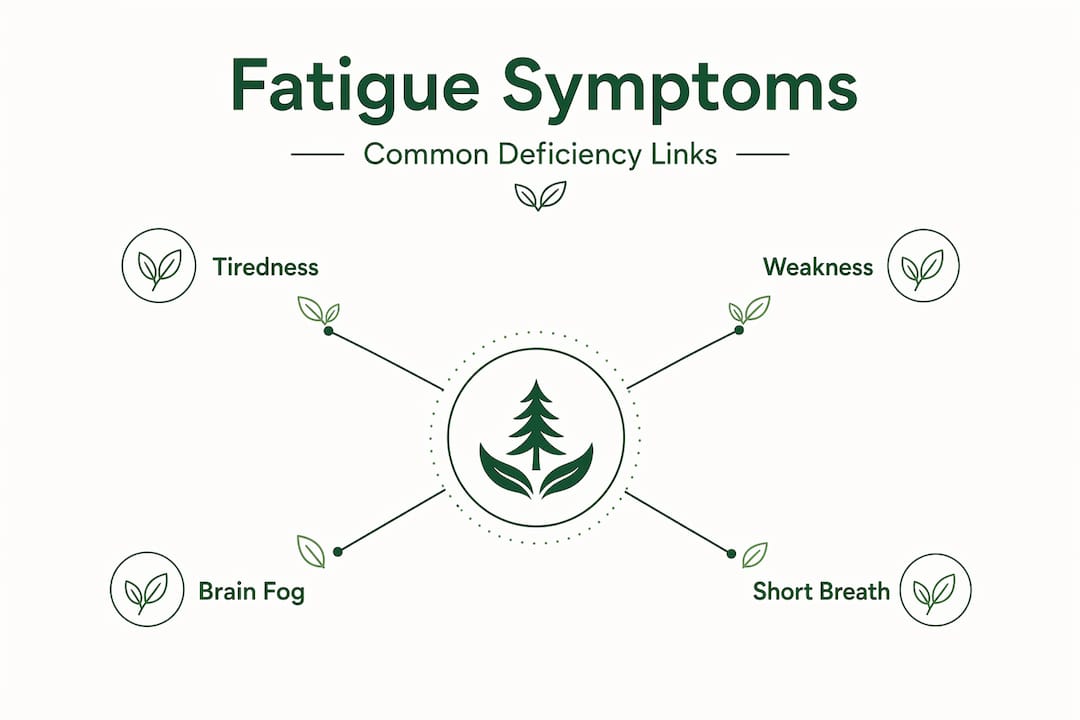
| Iron | Tiredness, pallor, shortness of breath, poor concentration | Women of reproductive age, vegetarians, those with gut disorders |
| Vitamin B12 | Fatigue, weakness, brain fog, tingling in hands and feet | Vegans, older adults, people on metformin or PPIs |
| Vitamin D | Muscle weakness, low mood, generalised fatigue | People with limited sun exposure, darker skin tones, housebound individuals |
| Magnesium | Fatigue, muscle cramps, poor sleep, irritability | Those under chronic stress, people with type 2 diabetes |
| Folate | Tiredness, mouth sores, difficulty concentrating | Pregnant women, heavy alcohol users, people with malabsorption |
Iron deficiency anaemia develops gradually as iron stores deplete over months, which is why many people do not notice the decline until fatigue becomes severe. The progression is slow and insidious. You adapt to feeling worse without realising how far your baseline has dropped.

Vitamin B12 deficiency produces fatigue and weakness that develop slowly too, which means it is frequently attributed to stress or ageing rather than a correctable nutrient gap. This is particularly common in people over 60, whose ability to absorb B12 from food declines with age.
One pattern worth highlighting separately: fatigue symptoms across all these deficiencies overlap considerably with symptoms of thyroid disorders, depression, and ME/CFS. This overlap is not a reason to avoid testing. It is a reason to test thoroughly.
Diagnosing nutrient deficiencies in chronic fatigue
Getting the right tests is where many people hit a wall. A standard full blood count may come back “normal” while a significant deficiency goes undetected. This happens most often with iron.
Iron deficiency without anaemia can still cause fatigue, cognitive impairment, and restless legs syndrome. Haemoglobin may be within the normal range while ferritin (the storage form of iron) is critically low. Practitioners who rely on ferritin and full iron studies rather than haemoglobin alone are far more likely to catch this early.
The tests worth asking about include:
-
Full iron studies including serum ferritin, transferrin saturation, and serum iron
-
Serum B12 and, where indicated, methylmalonic acid or homocysteine for functional B12 status
-
25-hydroxyvitamin D for vitamin D status
-
Serum magnesium (noting that this reflects only a fraction of total body magnesium)
-
Folate and zinc levels if dietary intake or absorption is a concern
-
Thyroid function tests (TSH, free T3, free T4) to rule out thyroid-related fatigue
For people with suspected ME/CFS, baseline blood tests are used primarily to exclude other illnesses. No single diagnostic blood test for ME/CFS currently exists. Repeated testing may be necessary, particularly if symptoms worsen over time.
Pro Tip: If your GP has only run a standard full blood count and told you everything looks fine, ask specifically for ferritin and vitamin D. These are not always included by default and are among the most commonly low values in people with persistent fatigue.
Treatment approaches for nutrient-related fatigue
Knowing you have a deficiency is only half the work. How you treat it, and how long you commit to treatment, determines whether you actually recover your energy.
-
Confirm the deficiency first. Supplementing without testing is guesswork. It can mask symptoms, delay proper diagnosis, and in some cases cause harm (excess iron, for example, is toxic).
-
Address the underlying cause. Iron deficiency treatment depends on finding why you are deficient. Blood loss, poor absorption, or inadequate dietary intake each require a different approach. Supplementing without investigating the cause often leads to the deficiency returning.
-
Choose the right delivery method. Oral iron supplements are the standard starting point, but they suit not everyone.IV iron or injections are medical treatments used to quickly replenish iron levels in patients suffering from iron deficiency anemia, especially when oral supplements are ineffective or not tolerated.are appropriate when oral supplements are poorly tolerated or absorption is impaired. For B12, severe deficiency with malabsorption is treated initially with multiple injections for rapid replenishment, with symptom response often seen within 48–72 hours.
-
Set realistic timelines. Iron supplements increase red blood cell production within 3–10 days, but correcting anaemia takes 3–6 weeks. Fully replenishing iron stores typically requires around six months of continued supplementation. Expecting to feel dramatically better in a week is a setup for disappointment.
-
Optimise absorption. Iron is best absorbed on alternate days, before meals, and alongside vitamin C. Calcium and dairy products inhibit absorption significantly, so timing matters.
-
Maintain levels long-term. People with pernicious anaemia or ongoing malabsorption require regular B12 injections every one to three months to prevent recurrence. This is not a short-term fix. It is an ongoing management strategy.
Pro Tip: When comparing iron treatment options, discuss with your doctor whether oral, injection, or infusion best suits your situation. The answer depends on your ferritin levels, tolerance, and the underlying cause of your deficiency.
Nutrient management within broader fatigue care
Correcting a nutrient deficiency can produce meaningful improvement in energy. But for many people with chronic fatigue, it is one part of a larger picture.
ME/CFS causes are not fully understood. Multiple factors including infections, genetics, inflammation, and changes in energy metabolism are under active study. Nutrient deficiencies are one aspect within this complex picture, not the primary driver in most cases.
What this means practically:
-
Treating a confirmed iron or B12 deficiency may lift a layer of fatigue, but if other factors are present, you may still feel unwell after correction.
-
Lifestyle factors including sleep quality, stress load, physical activity pacing, and dietary patterns all influence how well your body responds to nutrient repletion.
-
Conditions such as thyroid dysfunction, autoimmune disease, and hormonal imbalances can both cause fatigue and impair nutrient absorption, creating a cycle that requires medical attention rather than self-management alone.
-
Menopause-related fatigue is a common and frequently overlooked contributor in women over 40, often compounded by declining iron and vitamin D levels.
The most useful framing is this: nutrient repletion creates the conditions for recovery. It removes a barrier. But it works best as part of a plan that addresses sleep, stress, gut health, and any underlying medical conditions simultaneously.
My take on chronic fatigue and nutrient deficiencies
I’ve worked with enough people experiencing chronic fatigue to know that the nutrient conversation, while genuinely important, gets oversimplified constantly. Patients come in having already spent months taking iron tablets or B12 supplements they bought without testing, and they’re frustrated that nothing has changed. What I’ve found is that the frustration almost always traces back to two things: the wrong diagnosis or the wrong timeline.
The diagnosis problem is real. Fatigue has many causes, and nutrients are part of a broader approach. Treating what you assume is the problem rather than what the tests confirm is a common and costly mistake. The timeline problem is equally common. People expect to feel better in two weeks and give up at six. Iron repletion takes months. That’s not a failure of the treatment. That’s just biology.
What I tell patients is this: get the right tests, treat the confirmed deficiency properly, and give it the time it actually needs. Then reassess. If fatigue persists after a deficiency is genuinely corrected, that tells you something important. It means there’s more to find. And that’s where a thorough, root-cause approach becomes not just useful but necessary.
— Chris
How Evergreendoctors can help you recover your energy
If you’ve been living with persistent fatigue and suspect nutrient deficiencies may be involved, getting a clear, complete picture is the right first step.

At Evergreendoctors, the functional medicine approach goes beyond a basic blood test. The team investigates the full range of potential contributors to fatigue, including iron studies, B12, vitamin D, thyroid function, hormonal status, and gut health, then builds a personalised treatment plan around what your results actually show. Whether you’re in Sydney, on the Sunshine Coast, in Newcastle, or prefer to access care via telehealth, Evergreendoctors offers appointments designed to get to the root of your fatigue rather than simply manage it. Book a consultation and start with clarity.
FAQ
What nutrient deficiencies cause chronic fatigue?
The most common nutrient deficiencies linked to chronic fatigue are iron, vitamin B12, vitamin D, magnesium, and folate. Each impairs energy production through different mechanisms, and deficiencies often coexist.
Can you have iron deficiency without anaemia and still feel fatigued?
Yes. Iron deficiency without anaemia can cause significant fatigue, brain fog, and restless legs. Ferritin levels may be critically low even when haemoglobin appears normal, which is why full iron studies are needed.
How long does it take to recover energy after treating a deficiency?
It depends on the deficiency. B12 injections can improve symptoms within 48–72 hours in severe cases, while fully correcting iron deficiency anaemia typically takes 3–6 months of consistent treatment.
Are nutrient deficiencies the main cause of ME/CFS?
No. ME/CFS involves multiple factors including infections, immune dysfunction, and genetic influences. Nutrient deficiencies may contribute to or worsen fatigue in ME/CFS, but they are not the primary cause.
When should I see a doctor about chronic fatigue?
See a doctor if fatigue has persisted for more than four to six weeks, significantly affects your daily life, or comes with other symptoms such as brain fog, muscle weakness, or shortness of breath. A targeted blood panel is the appropriate starting point.