
If you’ve spent years managing a chronic condition and feel like conventional medicine only ever treats the surface, you’re not alone. Functional medicine principles explained through a root-cause lens offer something different: a structured, science-backed way of understanding why your body is struggling, not just what to call the problem. This approach treats the body as an interconnected whole where symptoms arise from imbalances across multiple systems, rather than isolated malfunctions in a single organ. The seven principles below break down exactly how this works.
Table of Contents
Key takeaways
| Point | Details |
|---|---|
| Root causes over symptoms | Functional medicine identifies upstream drivers of illness rather than managing symptoms in isolation. |
| Biochemical individuality matters | Your genetics and environment mean the same diagnosis can have entirely different causes in different people. |
| Patient participation is non-negotiable | Lasting outcomes depend on your active involvement in diet, sleep, stress management, and lifestyle change. |
| Systems are interconnected | A problem in one body system almost always affects others, which is why pattern recognition is central to this approach. |
| Optimal health is not just “normal” | Functional medicine targets vitality, not just the absence of diagnosed disease or a result within a standard lab range. |
1. Functional medicine principles explained: biochemical individuality
No two people are biologically identical. This is the foundation of functional medicine and the reason it rejects the idea that one treatment protocol fits everyone. Genetic and environmental variations influence how you respond to nutrients, medications, and lifestyle interventions in ways that are specific to you alone.

Consider two people who both receive a diagnosis of hypothyroidism. One may have an autoimmune trigger, another a nutritional deficiency in selenium or iodine, and a third may have a conversion problem turning T4 into active T3. The diagnosis is the same. The underlying cause is not. Treating all three identically will produce three very different outcomes.
This is where tools like nutrigenomics (how your genes influence your response to food) and pharmacogenomics (how your genes affect drug metabolism) become relevant. Functional medicine practitioners use these alongside detailed health histories to build protocols that match your biology, not a population average.
-
Two patients with the same diagnosis may require entirely different treatment pathways
-
Nutrient absorption, hormone conversion, and detoxification capacity all vary by individual
-
Environmental exposures across your lifetime shape how your body currently functions
-
Personalised protocols consistently outperform generic ones for chronic conditions
Pro Tip: If you’ve tried standard treatments without success, ask your practitioner whether your individual genetic or metabolic profile has been assessed. This single question can reframe your entire care plan.
2. Patient-centred care over disease-centred models
Conventional medicine is largely organised around diseases and the organs they affect. A cardiologist sees the heart. A gastroenterologist sees the gut. A rheumatologist sees the joints. Functional medicine sees you, the person, across all of it.
This shift sounds simple but it changes everything about how care is delivered. Functional medicine consultations typically run 60 minutes, particularly in the initial visit. That time is used to map your complete health timeline, including childhood illnesses, significant life events, dietary patterns, sleep history, and stress exposures. This is not small talk. It is clinical data.
The goal is collaborative. Your practitioner is not handing down a verdict. You and your practitioner are building a shared understanding of what has happened in your body and what needs to change. This collaborative model improves both adherence and outcomes because you understand the reasoning behind every recommendation.
-
Whole-person assessment includes physical, mental, emotional, and environmental factors
-
Deep history taking uncovers triggers and patterns that short consultations may miss
-
Collaborative goal setting means you’re more likely to follow through on lifestyle changes
-
Patients report feeling genuinely heard, which itself has measurable therapeutic value
Pro Tip: Before your first functional medicine consultation, write a detailed timeline of your health history, including when symptoms started, what changed in your life around that time, and what you’ve already tried. This preparation can cut weeks off the diagnostic process.
3. Dynamic balance between internal and external factors
Health is not a fixed state you either have or don’t have. It is a dynamic balance constantly shaped by what you eat, how you sleep, the stress you carry, the toxins you’re exposed to, and even the quality of your relationships. Functional medicine treats these not as lifestyle suggestions but as clinical variables.
Take chronic stress as a concrete example. Sustained psychological stress elevates cortisol, and elevated cortisol does not stay in one lane. It suppresses immune function, increases intestinal permeability (commonly called leaky gut), disrupts sex hormone production, and impairs thyroid conversion. One stressor, multiple systems affected. This is why a practitioner looking only at your thyroid panel may miss the actual driver entirely.
Functional medicine maps these mediators systematically. The approach asks:
-
What antecedents (predisposing factors from your past) set the stage?
-
What triggers (specific events or exposures) activated the problem?
-
What mediators (ongoing factors like poor sleep or high sugar intake) are keeping it active?
Addressing the mediators, not just the diagnosis, is what produces lasting change rather than temporary relief.
4. Interconnected physiological systems
One of the most useful reframes in understanding functional medicine is moving away from the idea that your body is a collection of separate departments. It is not. It is a complex, web-like network where a disruption in one system reliably creates ripple effects across others.
The Institute for Functional Medicine developed a clinical tool called the IFM Matrix, which maps patient data across seven core biological systems: assimilation (digestion and absorption), defence and repair (immune and inflammation), energy production, biotransformation and elimination (detoxification), transport (cardiovascular and lymphatic), communication (hormones and neurotransmitters), and structural integrity.
| Conventional view | Functional medicine view |
|---|---|
| Gut symptoms treated by gastroenterologist | Gut dysfunction assessed for links to immunity, mood, and hormones |
| Depression treated with antidepressants | Mood disorder assessed for nutritional, inflammatory, and hormonal drivers |
| Fatigue attributed to anaemia alone | Fatigue mapped across thyroid, adrenal, mitochondrial, and sleep systems |
| Skin conditions treated topically | Skin issues investigated for gut microbiome and detoxification connections |
This pattern recognition is what allows a functional medicine practitioner to connect a skin flare, a mood dip, and a digestive complaint and realise they are all downstream of the same upstream problem.
5. Health optimisation, not just disease absence
Conventional medicine defines health largely by the absence of diagnosed disease. If your lab results fall within the standard reference range, you’re told you’re fine. Functional medicine asks a different question: are you thriving, or are you just not sick enough to qualify for a diagnosis yet?
Functional Medicine labs are specialized diagnostic tools used by practitioners to assess the underlying causes of chronic health conditions. These labs often include comprehensive tests such as hormone panels, food sensitivity assessments, gut health analyses, and nutrient deficiency screenings. For example, a comprehensive stool analysis can reveal imbalances in gut bacteria, while a saliva hormone test might uncover adrenal fatigue or hormonal imbalances. By utilizing these advanced testing methods, healthcare providers can develop personalized treatment plans that address the root causes of health issues, aim help aim for optimal, rather than just managing symptoms. This distinction matters enormously in practice.
A TSH (thyroid stimulating hormone) result of 4.5 mIU/L sits within the standard reference range in most Australian pathology labs. But many functional medicine practitioners consider optimal TSH to sit between 1.0 and 2.5 mIU/L. A patient at 4.5 may be experiencing fatigue, weight gain, brain fog, and low mood and be told their thyroid is “normal.” The functional medicine approach would investigate further.
This does not mean every practitioner applies optimal ranges consistently or correctly. There is genuine variability in how these ranges are used, and it is worth asking your practitioner to explain the evidence behind the ranges they apply. The principle itself, however, is sound: aiming for vitality rather than the absence of a diagnosable condition produces better long-term health outcomes.
6. Nutrition as a primary therapeutic tool
Before supplements, before specialised protocols, functional medicine starts with food. This is not a philosophical preference. It reflects the evidence that diet, stress management, and sleep are critical components of treatment plans for virtually every chronic condition.
Food is information. Every meal sends signals to your genes, your gut microbiome, your immune system, and your hormones. A diet high in ultra-processed foods drives chronic low-grade inflammation, disrupts the gut lining, and dysregulates insulin and cortisol. A whole-food, nutrient-dense diet does the opposite. Functional medicine practitioners assess your specific nutritional status, including micronutrient levels, inflammatory markers, and gut health indicators, before recommending targeted dietary changes.
This is also where the holistic health principles underlying functional medicine align most clearly with the evidence. Addressing nutritional deficiencies and dietary patterns is not complementary care. It is foundational care.
7. Evidence-informed practice with formal training pathways
A common misconception about functional medicine is that it sits outside mainstream medicine or lacks rigorous training standards. This is not accurate. While functional medicine is not a recognised specialty, it is a legitimate, evidence-informed clinical approach with formal certification pathways through institutes such as the Institute for Functional Medicine. The Cleveland Clinic, the largest hospital network in the world, has an internal Functional Medicine clinic for complex patients.
Practitioners who complete these programmes bring both conventional medical training and additional competency in systems biology, advanced diagnostics, and lifestyle medicine. The certification and training pathways available to functional medicine practitioners are rigorous and continuing to grow in recognition across the healthcare sector.
What this means for you as a patient is that functional medicine complements rather than replaces conventional care. It is particularly well-suited to chronic conditions where conventional medicine has reached its limits, including autoimmune disease, metabolic disorders, hormonal imbalances, and persistent fatigue. For acute care, surgery, and emergency medicine, conventional medicine remains the gold standard. The two approaches are not in competition. They are best understood as complementary tools for different clinical situations.
My honest take on functional medicine
I’ve seen a lot of patients arrive at functional medicine after years of frustration with conventional care. They’ve had normal results, been told nothing is wrong, and yet they feel terrible. What strikes me every time is how quickly things shift when someone finally looks at the full picture.
That said, I’d caution against treating functional medicine as a magic alternative. Active patient participation is genuinely non-negotiable. Practitioners can identify the drivers of your condition, but you have to do the work of changing the lifestyle factors that are sustaining it. That is not a small ask.
I’d also encourage you to ask questions about your practitioner’s training. Certification matters. The field is growing quickly and the quality of practitioners varies. Look for someone with formal training from a recognised institute such as IFM or A4M, and don’t hesitate to ask how they approach the evidence behind their recommendations.
What I find most compelling about functional medicine is not any single principle. It’s the shift in the question being asked. Instead of “what drug treats this diagnosis?” the question becomes “why is this person’s body responding this way, and what does it need to function properly?” That reframe, in my experience, is where real and lasting health improvements begin.
— Annie
How Evergreendoctors brings these principles to you
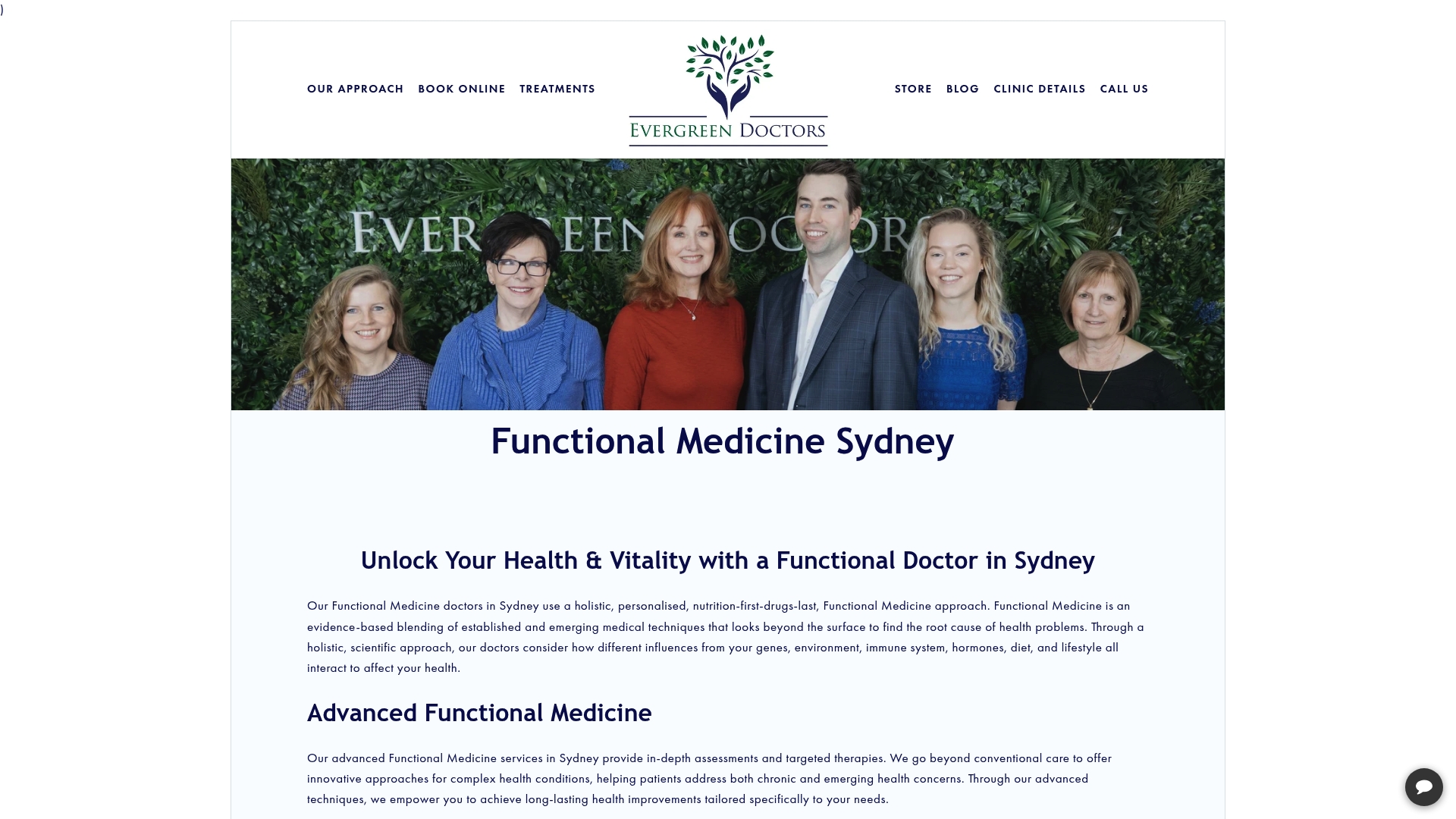
If these principles resonate with what you’ve been looking for in your own healthcare, Evergreendoctors offers exactly this approach for patients across Australia. Based in Sydney with functional medicine services in Newcastle and on the Sunshine Coast, and with full telehealth access for patients anywhere in the country, Evergreendoctors specialises in identifying the root causes of chronic conditions rather than managing symptoms in isolation.
Their functional medicine approach integrates advanced diagnostics, personalised nutrition planning, and targeted therapies built around your specific biology and health history. Whether you’re dealing with hormonal imbalances, metabolic issues, autoimmune conditions, or persistent fatigue, the team at Evergreendoctors builds a treatment plan around you, not a generic protocol. Book a consultation to find out what a root-cause assessment could reveal about your health.
FAQ
What is functional medicine in simple terms?
Functional medicine is a patient-centred approach that identifies the root causes of illness by examining how your genetics, lifestyle, and environment interact across interconnected body systems, rather than treating individual symptoms in isolation.
How is functional medicine different from conventional medicine?
Conventional medicine typically focuses on diagnosing and treating specific diseases by organ system. Functional medicine looks at the whole person, using longer consultations, advanced lab testing, and personalised protocols to address the underlying drivers of chronic conditions.
Are functional medicine practitioners properly qualified?
Yes. While functional medicine is not a standalone medical specialty, qualified practitioners complete formal training through accredited institutes and hold conventional medical or allied health qualifications alongside their functional medicine certification. Most doctors have completed other specialties such as GP Fellowships then proceeded to do further training in Functional Medicine.
What conditions does functional medicine help with?
Functional medicine is particularly effective for chronic conditions including hormonal, metabolic disorders, digestive dysfunction, persistent fatigue, and mood disorders where conventional approaches have not resolved the underlying cause.
How do functional medicine lab tests differ from standard tests?
Functional medicine labs use narrower optimal reference ranges to identify dysfunction before it reaches conventional disease thresholds, and may include markers for gut health, nutrient status, inflammation, and hormone metabolism that standard panels do not routinely assess. They also are sometimes offered by standard labs, but are not covered by Medicare so are not routinely done by your GP. For example a lipid subfraction panel is far more meaningful than the basic cholesterol panel.