
Chronic fatigue and hormonal connection is not a coincidence. Persistent, debilitating exhaustion is directly linked to dysfunction in the endocrine system, particularly involving cortisol, thyroid hormones, and sex hormones like oestrogen and progesterone. Myalgic encephalomyelitis/chronic fatigue syndrome (ME/CFS) is the recognised clinical term for the most severe form of this condition, affecting an estimated 250,000 Australians. The CDC identifies hormonal dysregulation as one of several biological causes of ME/CFS, alongside immune dysfunction and autonomic nervous system disruption. Understanding which hormones are involved, and why, is the first step toward finding real answers.
How does cortisol dysregulation contribute to chronic fatigue?
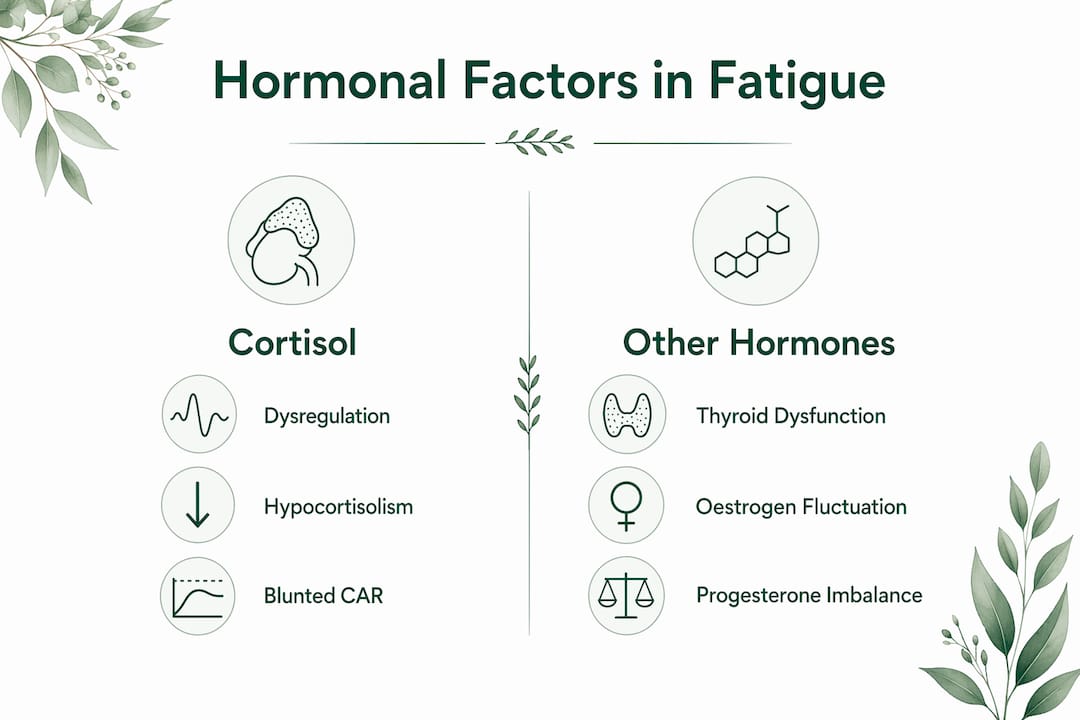
Cortisol is the body’s primary stress hormone, produced by the adrenal glands in response to signals from the hypothalamic-pituitary-adrenal (HPA) axis. Under normal conditions, cortisol peaks in the morning to promote alertness, regulates inflammation, and supports immune function throughout the day. In people with ME/CFS, this system does not work as it should.
Research consistently shows that ME/CFS patients have lower cortisol than healthy individuals, a pattern called hypocortisolism. The HPA axis becomes hyporeactive, meaning it underresponds to stress signals rather than overreacting. This matters because cortisol normally acts as a brake on immune activation. Without adequate cortisol, inflammation persists unchecked, which worsens fatigue, disrupts sleep, and amplifies pain sensitivity.

A landmark 2026 meta-analysis by Woo et al., drawing on 46 studies and 1,388 ME/CFS patients, confirmed significantly lower cortisol across salivary, urinary, and hair samples compared to healthy controls. This is the largest pooled analysis of its kind, and it points to a hyporeactive HPA axis as a core biological feature of the condition, not a secondary effect.
One particularly telling finding is the blunted cortisol awakening response (CAR). In healthy people, cortisol surges by 50 to 100 per cent within 30 minutes of waking. In ME/CFS patients, this surge is flattened or absent. The result is unrefreshing sleep, morning brain fog, and profound difficulty initiating daily activity. These are not psychological symptoms. They are measurable neuroendocrine events.
| Cortisol measure | Finding in ME/CFS |
|---|---|
| Salivary cortisol | Significantly lower than healthy controls |
| Urinary cortisol | Reduced 24-hour output confirmed across studies |
| Hair cortisol | Lower long-term cortisol accumulation |
| Cortisol awakening response | Blunted or absent morning surge |
| HPA feedback sensitivity | Exaggerated negative feedback, suppressing output further |
Pro Tip: Ask your doctor specifically about a cortisol awakening response test rather than a single random cortisol blood draw. Timing and method of collection dramatically change what the result reveals.
What roles do other hormones play in fatigue hormone imbalance?
Cortisol is not the only hormone involved. Thyroid dysfunction, adrenal insufficiency, and fluctuations in oestrogen and progesterone all produce fatigue symptoms that overlap significantly with ME/CFS. Identifying which hormones are contributing to your exhaustion requires looking at the whole endocrine picture.
Thyroid hormones and persistent tiredness
Hypothyroidism, where the thyroid gland produces insufficient T3 and T4, is one of the most common causes of fatigue in adults. Symptoms include cold intolerance, weight gain, cognitive slowing, and profound tiredness that sleep does not resolve. Thyroid dysfunction can mimic ME/CFS closely enough that it must be excluded before a CFS diagnosis is confirmed. Subclinical hypothyroidism, where TSH is mildly elevated but T4 remains normal, is frequently missed on standard panels.
Oestrogen, progesterone, and the perimenopause factor
Oestrogen and progesterone regulate sleep architecture, mood stability, and energy metabolism. When these hormones fluctuate, as they do during perimenopause, the effects on fatigue are substantial. Perimenopause affects sleep quality in roughly one-third of women through vasomotor symptoms like hot flushes and night sweats, but sleep disturbances in this group also occur independently of vasomotor triggers. Psychogenic symptoms, including anxiety, low mood, and cognitive fatigue, appear in up to 70% of women during menopause. That figure reflects how deeply hormonal shifts affect neurological function, not just reproductive health.
For women experiencing fatigue in their 40s and early 50s, the overlap between perimenopausal hormonal changes and ME/CFS-like symptoms is a genuine diagnostic challenge. Evergreendoctors addresses this directly through its menopause fatigue assessment approach, which considers both endocrine and lifestyle factors together.
Key hormonal contributors to fatigue beyond cortisol include:
-
Thyroid hormones (T3, T4): Deficiency slows metabolism and impairs cellular energy production
-
Oestrogen: Declining levels disrupt serotonin and dopamine pathways, worsening mood-related fatigue
-
Progesterone: Low levels impair sleep quality and increase anxiety, compounding exhaustion
-
DHEA: An adrenal precursor hormone that declines with age and chronic stress, reducing resilience and vitality
-
Insulin: Poor insulin sensitivity creates energy crashes and brain fog that mimic hormonal fatigue
How can hormonal imbalances causing chronic fatigue be diagnosed accurately?
Accurate diagnosis of endocrine system fatigue is harder than it sounds, and standard GP blood panels frequently miss the problem. A single morning cortisol reading, for example, tells you very little about HPA axis function across the day. Cortisol is highly time-sensitive, and cortisol abnormalities often only appear with time-stamped sampling or stimulation testing.
A thorough diagnostic process for hormonal fatigue could follow these steps:
-
Exclude mimicking conditions first. Anaemia, coeliac disease, autoimmune thyroiditis, sleep apnoea, and depression all produce fatigue that looks hormonal. These must be ruled out with targeted testing before attributing symptoms to HPA axis dysfunction.
-
Request dynamic cortisol testing. The cortisol awakening response (CAR) involves saliva samples at waking, 30 minutes, and 60 minutes post-waking. The ACTH stimulation test assesses adrenal reserve. Both are more informative than a random serum cortisol.
-
Assess the full thyroid panel. TSH alone is insufficient. Free T3, free T4, and thyroid antibodies (anti-TPO, anti-thyroglobulin) together reveal subclinical dysfunction and autoimmune thyroid disease.
-
Evaluate sex hormones in context. For women over 40, FSH, LH, oestradiol, and progesterone should be interpreted alongside symptom timing and menstrual cycle phase, not as isolated numbers.
-
Consider integrative assessment. Functional medicine practitioners assess nutrient cofactors like magnesium, B12, ferritin, and vitamin D alongside hormones, since deficiencies in these compounds directly impair hormone synthesis and receptor sensitivity.
Pro Tip: Bring a symptom diary to your appointment that tracks fatigue severity, sleep quality, and energy patterns across the day. This context helps clinicians interpret borderline hormone results far more accurately than numbers alone.
The chronic fatigue and nutrient deficiencies connection is worth exploring alongside hormonal testing, since low iron, B12, and magnesium can amplify every hormonal imbalance discussed here.
What holistic strategies support managing fatigue linked to hormonal imbalance?
Managing chronic fatigue tied to hormonal dysfunction requires more than a single prescription. Psychobiological interventions that integrate neuroendocrine and psychological perspectives show the most promise for addressing the stress-related hormonal hypo-reactivity seen in ME/CFS. That means combining lifestyle changes, targeted medical therapies, and psychological support into a personalised plan.
Practical strategies that support hormonal balance and reduce fatigue include:
-
Prioritise sleep architecture. Cortisol and growth hormone are both regulated by sleep quality. Cognitive behavioural therapy for insomnia (CBT-I) is an evidence-based first-line treatment for sleep disturbance in hormonal fatigue conditions, including perimenopause-related insomnia.
-
Regulate the stress response daily. Practices like diaphragmatic breathing, yoga nidra, and structured rest periods directly reduce HPA axis activation. Chronic psychological stress is one of the most potent suppressors of cortisol awakening response.
-
Optimise nutrition for hormone synthesis. Adequate dietary fat supports sex hormone production. Zinc, selenium, and iodine are required for thyroid function. Vitamin C and B5 support adrenal cortisol output. A nutrition-first approach is central to how Evergreendoctors structures fatigue management.
-
Consider hormone therapy where indicated. For perimenopausal women, hormone replacement therapy outcomes depend heavily on symptom cluster. HRT addresses vasomotor-driven sleep disruption effectively, but hormone therapy alone does not fully resolve all sleep or fatigue symptoms. Combining HRT with CBT-I produces better outcomes than either alone.
-
Track symptoms systematically. A structured diary covering energy, sleep, mood, and menstrual cycle data gives clinicians the information needed to adjust treatment over time. Apps like Bearable or paper-based tracking both work.
-
Seek specialist input early. An endocrinologist rules out primary adrenal or thyroid disease. A functional medicine practitioner then addresses the grey zone where results are “normal” but symptoms persist. Both perspectives are often needed.
Hormone balance treatment is most effective when it addresses root causes rather than suppressing symptoms. That distinction is what separates functional medicine from conventional symptom management.
Key takeaways
Chronic fatigue linked to hormonal imbalance requires dynamic testing, a full endocrine assessment, and a personalised combination of lifestyle, medical, and psychological strategies to address root causes effectively.
| Point | Details |
|---|---|
| Cortisol dysregulation is central | Blunted cortisol awakening response is a measurable biological feature of ME/CFS, not a psychological symptom. |
| Multiple hormones contribute | Thyroid, oestrogen, progesterone, and DHEA all produce fatigue when dysregulated, often simultaneously. |
| Standard tests frequently miss it | Dynamic cortisol testing and full thyroid panels are needed; random blood draws are insufficient. |
| Perimenopause is a major trigger | Up to 70% of women experience neurological fatigue symptoms during hormonal transition, requiring stratified treatment. |
| Holistic management works best | Combining CBT-I, nutrition, stress regulation, and targeted hormone therapy outperforms any single intervention. |
What I’ve learned about hormonal fatigue that most articles miss
After working with patients navigating unexplained exhaustion for years, the pattern I see most often is this: people arrive with normal test results and a growing sense that they are not being believed. Their cortisol is “within range.” Their thyroid is “fine.” Yet they cannot function.
The problem is that normal ranges are population averages, not individual optima. A cortisol awakening response that is technically within range but blunted by 60 per cent compared to that person’s baseline is clinically meaningful. Standard medicine does not always have the tools to see that. Functional medicine does.
What I find genuinely promising is the 2026 Woo et al. meta-analysis. It is the first large-scale confirmation that cortisol deficit in ME/CFS is real, measurable, and consistent across multiple sampling methods. That kind of evidence shifts the conversation from “is this hormonal?” to “which hormones, and how do we address them?”
The other thing I want to say directly: do not accept fatigue as inevitable. Hormonal fatigue is not a character flaw or a sign of weakness. It is a physiological state with identifiable causes and real treatment options. The patients who do best are those who advocate for thorough testing, track their symptoms carefully, and work with practitioners who treat the whole person rather than a single lab value.
Patience matters too. Hormonal recalibration takes months, not weeks. But with the right framework, genuine improvement is achievable.
— Annie
How Evergreendoctors supports hormonal fatigue recovery

Evergreendoctors takes a root-cause approach to chronic fatigue that goes beyond standard blood panels. Through functional medicine in Sydney and via telehealth consultations available across Australia, the team assesses the full hormonal picture including cortisol patterns, thyroid function, sex hormones, and nutritional cofactors. Patients on the Sunshine Coast and in Newcastle can access the same personalised care through local Sunshine Coast and Newcastle clinics. If you have been told your results are normal but you still feel exhausted, a functional medicine consultation is the logical next step.
FAQ
Can hormones cause fatigue even when blood tests are normal?
Yes. Standard blood panels measure hormone levels at a single point in time and compare them to population averages. Dynamic tests like the cortisol awakening response reveal dysfunction that random measurements miss entirely.
What is the difference between ME/CFS and hormonal fatigue?
ME/CFS is a clinical diagnosis defined by post-exertional malaise, unrefreshing sleep, and cognitive impairment lasting more than six months. Hormonal fatigue is a contributing mechanism within ME/CFS and other fatigue states, not a separate diagnosis.
Which hormone is most commonly linked to chronic fatigue syndrome?
Cortisol is the most researched hormone in ME/CFS. A 2026 meta-analysis of 46 studies confirmed significantly lower cortisol across multiple sampling methods in ME/CFS patients compared to healthy controls.
Does hormone replacement therapy help with fatigue in perimenopause?
HRT addresses fatigue driven by vasomotor symptoms and oestrogen deficiency, but hormone therapy does not fully resolve all sleep or fatigue symptoms. Combining HRT with CBT-I produces better outcomes for most women.
When should I see a specialist for hormonal fatigue?
See a specialist if fatigue has persisted for more than three months, disrupts daily function, and has not responded to basic lifestyle changes. An endocrinologist or functional medicine practitioner can order dynamic hormone testing and assess the full endocrine picture.