
If you have been diagnosed with an autoimmune condition, you have probably heard the same story: manage your symptoms, adjust your medication, and learn to live with it. Functional medicine and autoimmune conditions tell a different story. Rather than focusing on which drug suppresses your immune response, the functional medicine model asks why your immune system became dysregulated in the first place. That question changes everything. From the way you are tested to the way you eat, sleep, and manage stress, this approach treats you as an individual with a unique set of triggers, not a diagnosis on a page.
Table of Contents
-
Functional medicine and autoimmune conditions: the root cause view
-
Start your functional medicine journey with Evergreendoctors
Key takeaways
| Point | Details |
|---|---|
| Root causes matter more than symptoms | Functional medicine identifies triggers like gut dysfunction, toxin exposure, and infections that drive autoimmune activity. |
| Advanced testing guides treatment | Specialised labs beyond standard blood panels uncover hidden imbalances that conventional testing routinely misses. |
| Diet and lifestyle are front-line tools | Anti-inflammatory dietary approaches and stress management practices reduce flares and support long-term immune balance. |
| Functional medicine complements, not replaces, conventional care | Working with both a functional medicine practitioner and your specialist produces the safest and most effective outcomes. |
| Consistency outweighs perfection | Sustained lifestyle protocols deliver results that short-term fixes cannot, particularly for chronic autoimmune conditions. |
Functional medicine and autoimmune conditions: the root cause view
Autoimmune diseases are not one thing. Rheumatoid arthritis, Hashimoto’s thyroiditis, lupus, coeliac disease, multiple sclerosis, and over 80 other conditions all share a common mechanism: the immune system begins attacking healthy tissue as though it were a foreign threat. Understanding why that happens is where conventional and functional medicine part ways.
Conventional care typically classifies autoimmune conditions by the tissue being attacked and prescribes treatment accordingly. Functional medicine asks a prior question. What disrupted immune tolerance in the first place? The systems biology approach used in functional medicine maps the entire web of contributing factors rather than isolating a single mechanism.
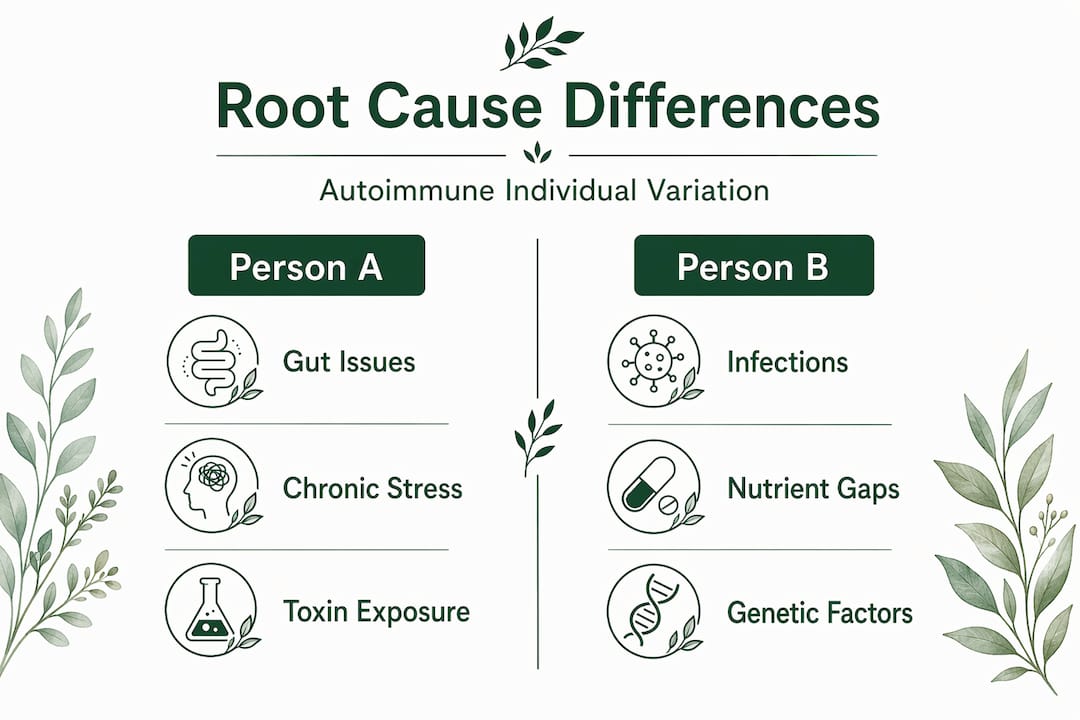
Several root-cause contributors appear repeatedly in autoimmune presentations:
-
Intestinal permeability (leaky gut): When the gut lining becomes compromised, partially digested proteins and bacterial fragments enter the bloodstream, triggering immune activation and, over time, misdirected immune responses.
-
Chronic infections: Pathogens like Epstein-Barr virus, Helicobacter pylori, and Borrelia species have been linked to immune dysregulation through molecular mimicry, where the immune system confuses the pathogen with self-tissue.
-
Environmental toxin exposure: Heavy metals, mould, and persistent organic pollutants impair mitochondrial function and dysregulate immune signalling. Immune dysregulation from environmental exposure is an area often overlooked in standard care.
-
Chronic psychological stress: Stress imapacts proinflammatory cytokines and damages the intestinal barrier, creating a cycle that accelerates immune dysregulation. Stress can significantly trigger molecular and immune modulation, affecting the distribution and trafficking of immune cells in various organs and altering their composition in the blood.
-
Hormonal imbalances: Oestrogen, cortisol, and thyroid hormones all modulate immune function. Disruption in any of these shifts the balance toward inflammation.
-
Nutritional deficiencies: Low levels of vitamin D, zinc, and omega-3 fatty acids consistently appear in autoimmune populations.
The critical insight here is that autoimmune triggers vary widely between individuals. Two people with identical Hashimoto’s diagnoses may have completely different root causes. That is precisely why functional medicine insists on personalised, comprehensive assessment rather than protocol-based treatment.
Advanced testing that changes the picture
Standard blood panels are a starting point, not a destination. When you see a conventional doctor for autoimmune disease management, you are typically offered inflammatory markers, full blood count, and organ function tests. These confirm that something is wrong. They rarely explain what triggered it.

Functional medicine practitioners use advanced labs that examine markers conventional medicine either ignores or does not yet routinely order. The difference is not just academic. Discovering that you have elevated zonulin levels (a marker of intestinal permeability) or active Epstein-Barr reactivation fundamentally changes your treatment pathway.
Testing in a thorough functional medicine evaluation typically includes:
-
Comprehensive stool microbiome analysis: Identifies bacterial imbalances, parasites, fungal overgrowth, and markers of intestinal permeability.
-
Expanded thyroid panel: TSH alone may be insufficient. Free T3, Free T4, reverse T3, and thyroid antibodies (TPO and TgAb) reveal the full picture, particularly for Hashimoto’s, though are not always needed. Levels of iodine, selenium, zinc, iron and tyrosine also matter.
-
Autoimmune antibody panels: Including ANA, anti-dsDNA, and condition-specific antibodies that may predict flares before symptoms intensify.
-
Chronic infection and conditions screenings: EBV, CMV, and H. pylori titres. Post tick bite Mammalian Meat Allergy.
-
Nutrient status: Red cell magnesium, vitamin D 25-OH, zinc, ferritin, and omega-3 index.
-
Hormone panels: Cortisol rhythm (ideally salivary six-point testing), sex hormones, and DHEA.
-
Organic acids and mitochondrial markers: Providing insight into cellular energy production and toxic metabolite accumulation.
In Australia, many of these tests are not covered by Medicare and can cost several hundred dollars out of pocket. That is a real consideration, and a good functional medicine practitioner will prioritise the tests most relevant to your clinical picture rather than ordering everything at once.
Pro Tip: Before your first functional medicine appointment, write down every symptom you experience including fatigue, brain fog, skin changes, digestive issues, and mood shifts. The more context you provide, the more precisely your practitioner can direct the testing.
Diet, lifestyle, and immune support
What you eat, how you sleep, and how you manage stress are not soft lifestyle advice. They are front-line tools in holistic autoimmune treatment. A whole food anti-inflammatory diets help alleviate biomarkers of inflammation and improve quality of life in autoimmune populations, though they work best alongside appropriate medical care.
Here is a practical framework for applying functional nutrition in an autoimmune context, but always discuss it first with your doctor:
-
Consider the Autoimmune Protocol (AIP) diet. AIP eliminates grains, legumes, dairy, eggs, nightshades, nuts, seeds, and alcohol for a defined period, then reintroduces foods methodically. It is not a permanent diet. It is a diagnostic tool that reveals individual food triggers with precision.
-
Transition toward a Mediterranean or whole-food anti-inflammatory pattern. Once triggers are identified, a Mediterranean-style diet provides sustained immune support through abundant polyphenols, fibre, and healthy fats. This pattern has the strongest long-term evidence base for autoimmune disease management.
-
Address specific nutrient gaps. Vitamin D deficiency is common in autoimmune patients and plays a direct role in immune regulation. Omega-3 fatty acids reduce inflammatory signalling. Probiotics and prebiotic fibres support the gut microbiome. These are not optional extras; they are foundational.
-
Prioritise sleep. Chronic sleep deprivation drives cortisol dysregulation, impairs immune tolerance, and worsens intestinal permeability. Seven to nine hours of quality sleep is not a luxury for someone managing autoimmunity.
-
Incorporate movement that supports rather than depletes you. Home-based physical activity including yoga and aerobic training shows measurable reductions in autoimmune symptoms and improvements in functional capacity. High-intensity training during a flare, however, can worsen symptoms for many people.
-
Reduce toxin exposure systematically. Swap personal care and cleaning products for low-toxin alternatives. Filter your drinking water. Check your home for mould if you have unexplained symptom worsening. These steps support detoxification pathways that are often compromised in autoimmune patients.
Pro Tip: The biggest mistake people make when starting dietary changes for autoimmune conditions is trying to change everything at once. Pick one area, whether that is eliminating gluten or improving sleep, and build consistency before adding the next change. Momentum matters more than speed.
Integrating functional and conventional care
Functional medicine does not ask you to abandon your rheumatologist or endocrinologist. A collaborative care model is not only sensible, it is safer. Medications like immunosuppressants, disease-modifying antirheumatic drugs (DMARDs), and biologics play a legitimate role in controlling severe autoimmune activity, particularly during acute flares.
What functional medicine adds is the layer beneath. While your specialist manages the immune response, your functional medicine practitioner works on the conditions that provoked it. Root cause exploration covers chronic infections, toxin exposure, and hormonal imbalances that conventional rheumatology is not designed to address.
The table below illustrates where the two approaches differ and where they complement each other:
| Area | Conventional medicine | Functional medicine |
|---|---|---|
| Primary focus | Suppress immune activity and control symptoms | Identify and remove triggers causing immune dysregulation |
| Diagnostic tools | Standard blood panels, imaging, biopsy | Advanced labs including microbiome, antibody panels, nutrient status |
| Treatment tools | Pharmaceuticals (DMARDs, biologics, steroids) | Diet, supplementation, lifestyle change, targeted nutraceuticals |
| View of gut health | Relevant only in GI-specific conditions | Central to immune function in nearly all autoimmune cases |
| Long-term goal | Manage disease progression | Restore immune tolerance and reduce reliance on medication over time |
| Patient role | Follow treatment protocol | Active participant in a personalised health plan |
Medication tapering, when appropriate, should always happen in partnership with your prescribing specialist. Functional medicine supports that process by building the physiological resilience needed to make it sustainable.
My take: what most practitioners miss
I have spent years working with people who come in frustrated, dismissed, and carrying a folder full of normal test results that clearly do not reflect how unwell they feel. What I have learned is that autoimmune conditions are not mysteries. They are patterns. And the patterns can trace back to something the conventional model did not think to look for.
The most common misconception I encounter is that functional medicine is about taking supplements instead of medication. It is not. The real work is investigative. You cannot throw a handful of fish oil capsules at a dysregulated immune system and expect transformation. What actually moves the needle is identifying your specific triggers, whether that is a latent infection you have been carrying for a decade, a gut microbiome shaped by years of antibiotics, or a cortisol pattern that tells your immune system to stay on high alert.
I also want to be honest about time. Healing autoimmune conditions through a root-cause approach takes months, sometimes longer. Patients who accept that upfront and commit to the process consistently outperform those looking for a quick resolution. The body heals on its own schedule. Your job is to remove the obstacles and give it what it needs to be in the best shape to heal.
— Annie
Start your functional medicine journey with Evergreendoctors
If you are ready to move beyond symptom management and understand what is actually driving your autoimmune condition, Evergreendoctors offers a genuinely different approach to your care.
Evergreendoctors provides personalised functional medicine consultations from their Sydney practice, with services extending to Newcastle, the Sunshine Coast, and Brisbane. Telehealth appointments are available for those across Australia who cannot attend in person, accessible through their functional medicine telehealth service. Every patient receives a thorough clinical evaluation, advanced diagnostic testing tailored to their presentation, and a treatment plan that integrates nutrition, lifestyle, and targeted therapies. Whether you are newly diagnosed or have been managing your condition for years, a discovery consultation is the first step toward understanding why your immune system became dysregulated and what you can genuinely do about it.
FAQ
What does functional medicine do differently for autoimmune disease?
Functional medicine investigates the root causes of immune dysregulation, including gut permeability, chronic infections, nutritional deficiencies, and toxin exposure, rather than focusing solely on suppressing immune activity with medication.
Which diet is best for autoimmune conditions?
The Autoimmune Protocol (AIP) diet is commonly used as a diagnostic elimination tool, while a Mediterranean anti-inflammatory diet provides the strongest long-term evidence for reducing inflammatory biomarkers and supporting immune balance.
Can functional medicine replace my specialist’s care?
No. Functional medicine complements conventional care rather than replacing it. Working with both a functional medicine practitioner and your specialist produces the safest and most thorough outcomes for complex autoimmune conditions.
What tests does a functional medicine doctor order for autoimmune conditions?
Beyond standard panels, functional medicine practitioners typically order comprehensive labs including stool microbiome analysis, intestinal permeability markers, expanded thyroid antibody panels, chronic infection screenings, and detailed nutrient status assessments.
How long does it take to see results with functional medicine for autoimmune conditions?
Results vary significantly based on the individual’s root causes and the severity of their condition. Most patients notice meaningful improvements within three to six months of consistent dietary, lifestyle, and targeted therapeutic changes, with deeper healing continuing over a longer period.