
If you’ve spent years cycling through specialist appointments, collecting diagnoses that explain your symptoms but not why you have them, you’re not alone. Functional medicine and personalised treatment take a fundamentally different position: your health is not a collection of isolated symptoms to suppress, but a dynamic system shaped by your genes, environment, and life history. This guide explains how this approach works, what cutting-edge tools now make it measurable, and how to evaluate providers so you get genuinely evidence-based care rather than expensive guesswork.
Table of Contents
Key takeaways
| Point | Details |
|---|---|
| Root-cause focus | Functional medicine identifies underlying drivers of illness rather than simply managing symptoms. |
| Multi-omics precision | Genomics, metabolomics, and microbiome data allow treatment plans to be built around your specific biology. |
| AI accelerates integration | Artificial intelligence synthesises complex biomarker data into clinically useful decisions faster than any manual review. |
| Credential checks matter | Provider training varies widely, so verifying qualifications and evidence orientation protects you from unproven protocols. |
| Dynamic, not static | Effective personalised plans are adjusted over time based on biomarker monitoring and shifting health contexts. |
Functional medicine and personalised treatment: the core principles
Functional medicine is the recognised clinical term for what many people describe as “root-cause medicine.” The personalised treatment that flows from it is sometimes called precision medicine or integrative medicine in academic literature. Both phrases describe the same shift: moving away from population-level protocols toward care that reflects who you are at a molecular and contextual level.
The approach rests on several defining features:
-
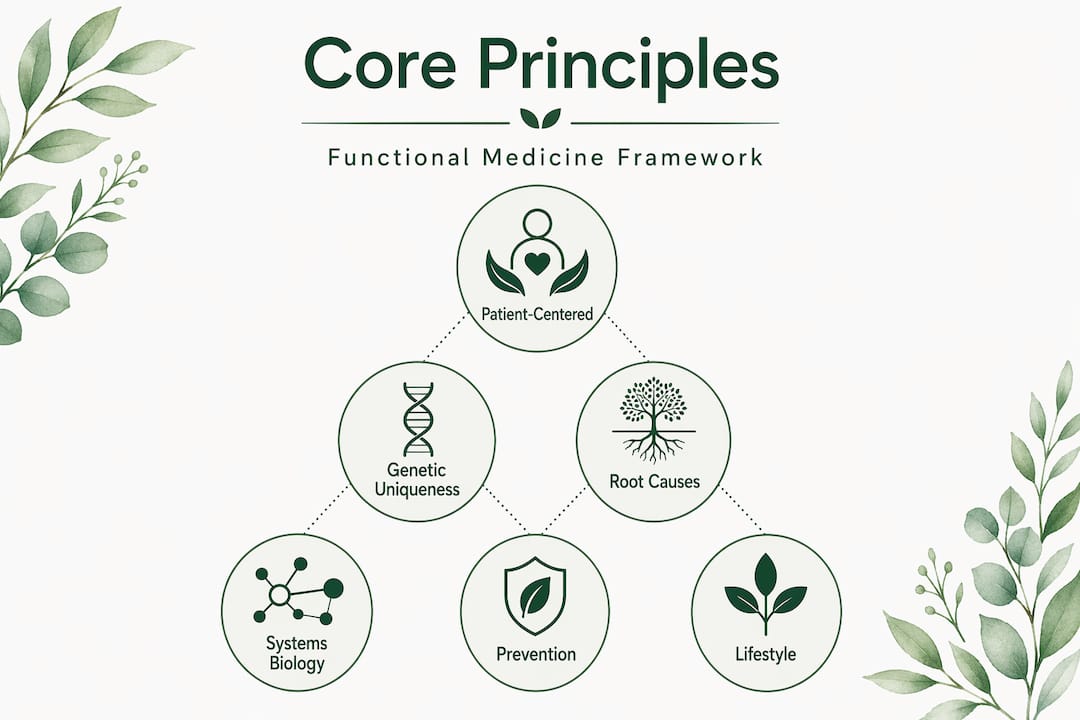
Systems biology thinking. Rather than treating the cardiovascular system separately from the gut, or hormones separately from mood, functional medicine maps interactions between body systems to find where dysfunction originates.
-
Comprehensive evaluation. Functional medicine initial visits often last up to an hour and include detailed patient histories, advanced testing, and assessment of environmental and lifestyle factors that conventional appointments rarely capture.
-
Advanced diagnostic testing. Organic acid profiles, hormone panels, micronutrient assessments, and genetic markers are used routinely to build a biological picture conventional blood work misses.
-
Collaborative care model. Patients are expected to participate actively. You bring your history, your goals, and your context. The clinician brings interpretation and clinical judgement. Neither works well without the other.
What separates this from conventional medicine is not scepticism toward pharmaceuticals or surgery. Functional medicine integrates conventional treatments where they are appropriate. What changes is the question being asked. Conventional medicine asks, “What condition does this symptom match?” Functional medicine asks, “Why has this person developed this condition in this context?” That shift in framing leads to very different treatment plans.
The seven core principles guiding functional medicine practice include patient-centred care, attention to genetic uniqueness, and the recognition that one upstream imbalance often produces multiple downstream symptoms. Understanding these principles helps you assess whether a provider is genuinely practising functional medicine or simply relabelling conventional care.
The technology behind personalised care
The gap between the theory of personalised treatment and its practical delivery has historically been enormous. That gap is closing fast, largely because of multi-omics technologies and artificial intelligence.
Multi-omics refers to layered biological measurement across several domains:
| Omics layer | What it measures | Clinical application |
|---|---|---|
| Genomics | DNA variants and gene expression | Drug metabolism, disease predisposition |
| Proteomics | Protein activity patterns | Inflammatory pathways, organ function |
| Metabolomics | Metabolic byproducts in blood and urine | Nutrient deficiencies, toxic load, energy metabolism |
| Microbiomics | Gut microbial composition | Immune function, mood, glycaemic response |
| Chronomics | Biological timing patterns | Optimal treatment windows, circadian disruptions |
Integrated omics combined with AI multimodal models support dynamic clinical decision making by mapping a patient’s molecular baseline alongside their temporal rhythms and environmental exposures. This is a significant advance. Previous personalised approaches often captured a single snapshot of biology. What these tools add is context over time.
The microbiome layer is particularly telling. Gut microbiota-based algorithms now predict glycaemic and lipid responses with enough accuracy to inform nutrition and clinical interventions. Two people can eat identical meals and experience dramatically different blood glucose responses based on microbiome composition alone. Standard dietary advice accounts for none of this.
Where AI adds distinct value is in synthesis. AI multimodal models translate complex molecular, environmental, and temporal interactions into clinical decisions that would take a clinician hours to map manually. This does not replace clinical judgement. It amplifies it.
Pro Tip: When reviewing your own test results with a functional medicine practitioner, ask specifically which omics layers were assessed and how each result changed your treatment plan. If a test result did not alter any recommendation, its clinical value should be questioned.
There are real limits here worth acknowledging. Not all biomarkers lead to clear treatment pathways, and clinician judgement remains essential for interpreting data that sits outside established clinical thresholds. Multi-omics testing is expensive, and access in Australia varies by location. Explore precision nutrition applications to understand what specific testing combinations have the strongest evidence base.
Choosing a provider: what you need to know
The term “functional medicine” is not a protected title in Australia. Anyone can use it. This means the quality of care behind that label varies from rigorously evidence-based to poorly substantiated. Knowing how to evaluate a provider protects you from wasted money and potential harm.
Patients should ask providers specific questions about training, the rationale for tests ordered, risk-benefit analysis of proposed interventions, and how outcomes will be measured. Here is a practical checklist for your first consultation:
-
Ask about formal training in functional or integrative medicine and which professional bodies the practitioner is registered with.
-
Request a clear explanation of why each recommended test was chosen and what clinical decision it informs.
-
Ask how progress will be measured. Vague answers about “feeling better” are insufficient. Look for specific biomarkers and reassessment timelines.
-
Clarify how the functional medicine approach will work alongside any conventional treatments you are already receiving.
-
Ask whether the practitioner follows published clinical guidelines for chronic conditions being treated.
The distinction between functional and integrative practitioners also matters. Integrative medicine is a broader category that encompasses mind-body therapies, acupuncture, and nutritional medicine alongside conventional care. Functional medicine is a specific methodology within that broader space, focused on systems biology and root-cause analysis. Neither is inherently superior, but knowing which you are receiving helps set appropriate expectations.
On the technology side, AI-driven personalised medicine carries its own ethical considerations. High expert consensus exists on 55 ethical recommendations covering dynamic consent, continuous validation, bias mitigation, and human oversight for AI tools used in patient care. Any provider using AI-based tools to guide treatment should be able to explain what safeguards govern those tools. If they cannot, treat that as a warning signal.
Pro Tip: Before committing to an extensive testing panel, ask whether the same clinical insight could be obtained from a narrower set of well-validated tests. More data is not always better data.
Resources like this guide on finding a qualified practitioner can help you prepare the right questions before your first appointment.
Practical applications: what personalised care looks like
Understanding the theory of personalised functional medicine is one thing. Seeing how it plays out in a real patient journey is another. Here is how custom health plans typically translate from data to daily life.
Personalised nutrition
Multi-omics has arguably had its greatest clinical impact in nutrition. Multi-omic approaches improve glycaemic control and lipid profiles better than standard dietary recommendations in cardiometabolic disease. This is not about following a trending diet. It is about mapping your specific metabolic responses and building an eating pattern that works for your biology, not a population average.

Critically, these plans require iteration. Effective personalised nutrition plans require ongoing adjustment and monitoring rather than a single static prescription. Your microbiome shifts. Your stress levels change. A plan built in January may need revision by June.
Chronic illness and complex conditions
Holistic treatment options within functional medicine are particularly relevant for conditions that conventional medicine struggles to resolve: autoimmune disorders, chronic fatigue, metabolic dysfunction, and hormonal imbalances. A typical patient journey through functional medicine for these conditions might look like this:
-
Detailed intake assessment covering symptoms, history, diet, stress, sleep, and environmental exposures over 60 to 90 minutes.
-
Targeted laboratory testing spanning relevant omics layers based on clinical presentation.
-
Treatment plan construction integrating nutrition, supplementation, lifestyle modification, and conventional treatment where indicated.
-
Follow-up at six to eight weeks with biomarker reassessment to evaluate response.
-
Plan revision based on objective data and patient-reported outcomes.
-
Ongoing monitoring with decreasing frequency as stability improves.
This iterative structure is what separates genuine personalised wellness strategies from a single consultation that produces a list of supplements. The value lies in the follow-through, not the initial testing.
Functional medicine works best when it integrates with conventional care rather than replacing it. Patients managing serious chronic illness should expect their functional medicine practitioner to communicate with their GP or specialist, not operate in a separate silo.
My perspective on where this is heading
I’ve watched functional medicine move from a fringe concept to a genuinely evidence-supported practice over the past decade, and the shift has been striking. What changed most is not the philosophy, which was always sound, but the measurement capacity. We now have tools that make personalised care real rather than aspirational.
What I’ve learned from observing both the promise and the pitfalls is this: the patients who get the most from functional medicine are the ones who show up as active participants. They track their responses, ask hard questions, and push back when recommendations lack a clear evidence rationale.
The technology is genuinely impressive. AI-enabled synthesis of multi-omics data can surface patterns no clinician would catch manually. But I’ve also seen providers use the language of precision medicine to dress up protocols that are neither precise nor well-evidenced. AI-enabled treatment protocols must meet the same safety and oversight standards as any other clinical tool. That standard is not consistently applied across the industry, and patients bear the risk when it is not.
My honest view is that the greatest near-term gains will come not from more sophisticated testing, but from better clinical interpretation of existing data. The bottleneck is rarely the data. It is the judgement applied to it.
— Annie
Evergreendoctors: personalised care grounded in evidence
Evergreendoctors practises functional medicine in a way that takes the science seriously. Whether you are managing a chronic condition, dealing with hormonal disruption, or simply not getting answers from standard healthcare, their approach starts with understanding your biology in full before making recommendations.
Consultations are available in Sydney, Newcastle, and on the Sunshine Coast, with telehealth options for patients across Australia. Every treatment plan is built around your specific data, reassessed as your health evolves, and integrated with any conventional care you are already receiving. If you are ready to move from symptom management to root-cause resolution, Evergreendoctors is a credible place to start that conversation.
FAQ
What is functional medicine?
Functional medicine is a clinical methodology focused on identifying and addressing the root causes of illness using systems biology, detailed patient history, and advanced diagnostic testing. It differs from conventional medicine by examining why a condition developed rather than simply matching symptoms to a diagnosis.
How does functional medicine work in practice?
A functional medicine consultation typically begins with a comprehensive intake lasting up to an hour, followed by targeted laboratory testing across relevant biological systems. Treatment plans integrate nutrition, lifestyle changes, and conventional therapies, then are adjusted based on ongoing biomarker monitoring.
What is multi-omics and why does it matter for personalised care?
Multi-omics refers to the layered analysis of genomic, metabolic, microbiome, and other biological data to build a precise picture of an individual’s health. When combined with AI, this data enables treatment decisions tailored to your specific molecular profile rather than population-level averages.
How do I know if a functional medicine provider is qualified?
Ask about formal training, professional registration, the evidence base for recommended tests, and how outcomes will be measured. Credentials vary widely in Australia, so requesting clarity on these points before committing to a treatment plan is essential.
Can functional medicine work alongside conventional treatment?
Yes, and it works best when it does. Functional medicine integrates with GP care, specialist management, and pharmaceutical treatment rather than replacing them. A good practitioner will actively communicate with your existing medical team.