
Most people assume a diagnosis needs a test. A scan, a blood panel, a biopsy. Something measurable and objective. But thorough history-taking can yield an accurate diagnosis in up to 74% of patient cases, before a single test is ordered. This is precisely why functional medicine takes your whole history as its starting point. Not as a formality, but as a diagnostic act. Understanding your full story, including what happened to your body years or decades ago, is often the most direct path to understanding what is happening now.
Table of Contents
Key takeaways
| Point | Details |
|---|---|
| History drives diagnosis | A thorough patient history can accurately identify the cause of illness in up to 74% of cases without extensive testing. |
| Whole history reveals root causes | Functional medicine maps connections across genetics, environment, diet, and stress to find where chronic illness begins. |
| Patients are active contributors | Sharing your full story, including childhood health and occupational exposures, directly shapes the accuracy of your treatment plan. |
| Structure and teamwork matter | Functional medicine uses organised, team-based history formats to avoid the omissions common in rushed conventional visits. |
| Preparation improves outcomes | Patients who arrive with detailed health timelines give practitioners the data needed to personalise care effectively. |
Why whole history matters in functional medicine
Most clinical encounters begin with the chief complaint. What brought you in today? That question is reasonable, but it can also set a ceiling on the conversation. Conventional care often stops at symptoms and works backwards through a limited set of diagnostic tests. Functional medicine starts somewhere different.
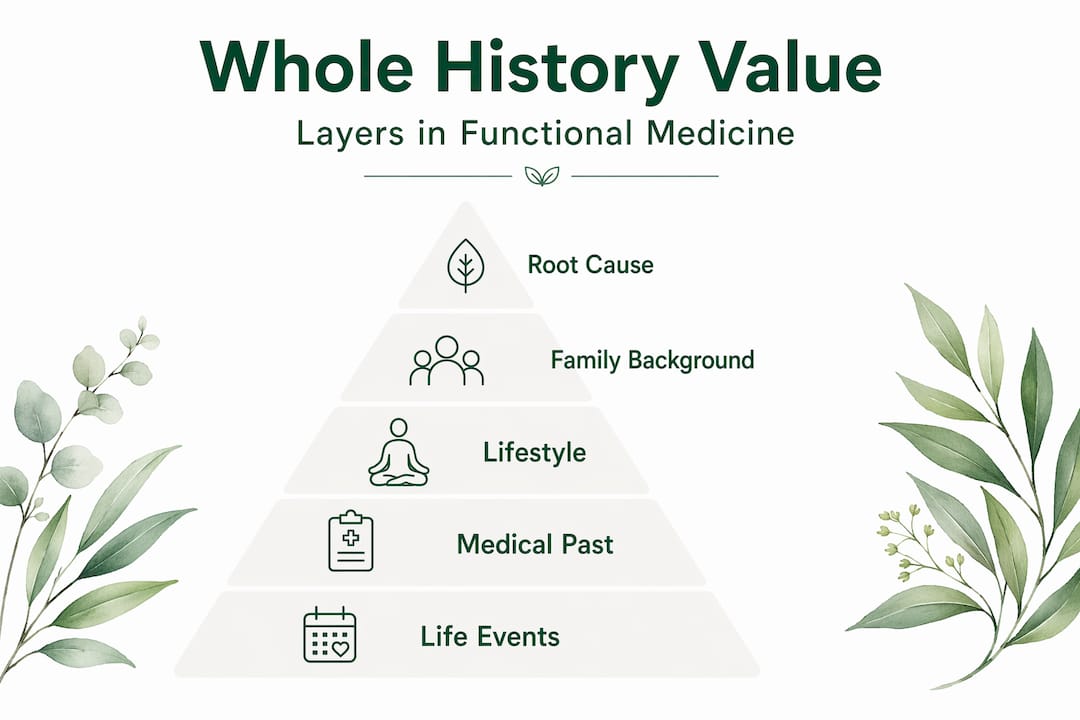
The whole history in functional medicine covers several distinct categories:
-
Medical history: Past illnesses, hospitalisations, surgeries, and medications, including those taken years ago
-
Family history: Genetic predispositions to conditions such as autoimmune disease, cardiovascular illness, or metabolic dysfunction
-
Environmental exposures: Occupational chemicals, household toxins, geographical factors, and long-term pollution exposure
-
Lifestyle factors: Sleep quality, dietary patterns over time, physical activity, and alcohol or substance use
-
Mental and emotional health: Chronic stress, trauma history, anxiety, depression, and significant life events
-
Social context: Relationships, support networks, financial stress, and cultural background
Each of these categories is a potential thread. Pulled in isolation, it tells you little. Woven together, a more complete picture of health starts to emerge that no single test could produce on its own.
The reason this breadth matters comes down to how the body actually works. Systems biology, the framework underpinning functional medicine, recognises that imbalances in one system cascade into others. Gut dysfunction influences immune function. Chronic stress disrupts hormonal balance. Poor sleep impairs metabolic regulation. No symptom exists in isolation, and no history element is truly irrelevant.
Pro Tip: Write down your health timeline before your first functional medicine appointment. Include major illnesses, medications, significant stressors, and dietary shifts by decade. This single document can save a full hour of consultation time and dramatically sharpen early clinical thinking.
How history guides root cause investigation
Here is where functional medicine history-taking becomes genuinely diagnostic rather than administrative. The medical history remains the most significant data point available to any clinician, and in functional medicine, it directly determines which investigations are worth pursuing and which can be skipped.
Consider a patient presenting with fatigue, weight gain, and low mood. In a conventional setting, this might trigger a standard thyroid panel and a mental health screening. If both come back within normal range, the appointment often ends there. But a thorough functional history might reveal that this same patient:
-
Grew up in an area with heavy industrial pollution
-
Started a high-stress job eight years ago, around the same time symptoms began
-
Has a mother with Hashimoto’s thyroiditis
-
Has eaten a highly processed diet for most of their adult life
-
Sleeps fewer than six hours most nights
Suddenly the picture changes. The investigation becomes far more targeted. Functional medicine providers spend more time with patients and ask deeper questions precisely because these patterns, invisible in a single blood test, are visible across a detailed history.
There is also a relational benefit that directly affects data quality. Building trust through listening is not just a nice clinical quality. It is a practical necessity. Patients who feel genuinely heard are more willing to share embarrassing, uncomfortable, or seemingly irrelevant details, and those details frequently turn out to be diagnostically significant.
“Symptoms are best viewed as information rather than problems to suppress. A thorough history is the lens that brings that information into focus.” — Functional medicine principle, as explained by practitioners working within the root cause model
The contrast with conventional approaches is stark. 60% of adults live with at least one chronic condition, with 40% managing two or more. Many of these people have been through rounds of standard care that addressed their most visible symptom without meaningfully improving their overall health. Functional medicine’s history-based model exists as a direct response to that gap.
Structured history-taking versus conventional approaches

One of the less-discussed differences between functional medicine and conventional care is not just what information gets collected, but how it gets collected and by whom.
In conventional medicine, history-taking is often a rushed, solo act. The GP has ten to fifteen minutes. The patient speaks, the clinician types, and the focus narrows quickly to whatever brought the person in that day. Details fall through the gaps not because of negligence but because the system is not designed for depth and breadth.
Functional medicine uses a different model. Structured history-taking involves multiple health professionals with clearly assigned roles, reducing redundancy and improving the completeness of the information gathered. A nutritionist, a nurse, and the lead practitioner might each contribute to different parts of the history, then synthesise findings collaboratively. The result is a richer, more layered clinical picture.
| Feature | Conventional care | Functional medicine |
|---|---|---|
| Consultation length | Typically 10 to 15 minutes | Often 45 to 90 minutes initially |
| History scope | Chief complaint and recent symptoms | Lifetime health, environment, and lifestyle |
| Team involvement | Usually single clinician | Multidisciplinary input common |
| Test-first tendency | Frequent | History guides test selection |
| Follow-up depth | Symptom monitoring | Ongoing story refinement |
Technology is beginning to play a supporting role in this process. AI tools can optimise workflow in history-taking, helping practitioners track and flag patterns across large amounts of patient data. But they cannot replace the clinical judgement required to interpret the meaning behind a patient’s account, or the relational skill needed to help a patient feel safe enough to share it fully.
Pro Tip: If you are transitioning from conventional to functional care, ask your new practitioner for a comprehensive intake form before your appointment. Completing it thoughtfully, not just ticking boxes, gives your clinician a significant head start and means your first consultation goes deeper, faster.
How to prepare your whole health history
Most people underestimate how much they actually know about their own health, and how much of it is clinically relevant. The challenge is that this knowledge is usually scattered across memory, old records, and information that never felt worth mentioning to a doctor.
Here is how to organise it before seeing a functional medicine practitioner:
-
Start with a decade-by-decade timeline. Note any significant illnesses, injuries, or periods of poor health. Include childhood conditions such as recurrent infections, eczema, or digestive issues.
-
List all medications and supplements, past and present. Include the reason you took them and, if known, the duration. Long-term antibiotic use or steroid courses are particularly relevant.
-
Document dietary patterns over time. Not just what you eat now, but how your diet has shifted. A move toward processed food during a stressful period, or years on a restrictive diet, can both be meaningful.
-
Record your environmental exposures. Where you grew up, where you have worked, and any significant exposures to chemicals, moulds, or pollutants.
-
Include your stress history. Major life events, periods of sustained anxiety, grief, relationship breakdown, or work pressure all have documented physiological effects.
Patients sharing details that seem unrelated to their current complaint, such as childhood infections or decades-old occupational stress, are giving their practitioner the raw material for connecting dots that conventional care never had the time to look for. The functional medicine principles that guide this approach treat the body as a single, interconnected system, and your history is the map.
Pro Tip: If you are unsure whether something is relevant, include it anyway. In functional medicine, the practitioner decides what matters diagnostically. Your job is to provide the complete picture. Erring on the side of more detail is almost always the right call.
Finding the right practitioner to receive that history is just as important as preparing it. Look for clinicians who allocate adequate time, ask follow-up questions, and revisit your history as your case evolves. A guide on finding a qualified practitioner can help you know what to look for before you book.
My perspective on listening as a diagnostic act
I have spent years observing how health outcomes shift when practitioners genuinely commit to the whole history. What strikes me most is not the volume of information gathered, but the quality of the clinical thinking that follows. When a practitioner takes the time to hear the full arc of a patient’s health story, the treatment plan that emerges is almost unrecognisable compared to what a ten-minute consult would have produced.
What I find concerning is how often comprehensive history-taking is framed as a luxury within modern healthcare, something to aspire to but rarely achievable given system constraints. This framing gets things backwards. Taking time for a full history is not a time drain. It is an investment that reduces unnecessary testing, avoids misdiagnosis, and builds the kind of patient engagement that actually leads to lasting change.
The uncomfortable truth is that many people with chronic illness have had their history collected superficially for years, and they have learned to self-censor as a result. They stop mentioning the stress, the childhood infections, the decade of disrupted sleep, because no one ever connected those things to their current state. Functional medicine asks them to unlearn that habit, and that is often the most therapeutic thing that happens in a first appointment.
This is something that sits at the core of what Evergreen Doctors practises every day. Your story is not background noise. It is the data.
— Annie
Personalised care that starts with your story
If this approach resonates with you, Evergreen Doctors offers exactly this kind of depth. Based in Sydney with clinics in Newcastle and the Sunshine Coast, as well as telehealth access across Australia, the Evergreen Doctors team brings together experienced practitioners who treat your full health history as the foundation of every clinical decision.
Their integrative approach goes beyond symptom relief, using your complete background to design personalised plans that address chronic conditions, hormonal imbalances, and metabolic issues at their source. Whether you are dealing with a condition that has never fully resolved or looking for care that actually accounts for your whole life, Evergreen Doctors is the place to start that conversation.
FAQ
What does “whole history” mean in functional medicine?
Whole history in functional medicine refers to a comprehensive account of a patient’s lifetime health, covering past illnesses, family background, diet, environment, stress, and mental health. It goes well beyond the presenting complaint to reveal the conditions in which chronic illness developed.
Can a health history really replace diagnostic testing?
A thorough history can accurately diagnose up to 74% of cases on its own, though functional medicine typically uses history to guide targeted testing rather than eliminate it entirely. The history determines which tests are worth ordering, making the process more precise and less costly.
Why does functional medicine ask about childhood health?
Conditions and exposures from early life, including recurrent infections, dietary patterns, and environmental factors, can create physiological imbalances that surface as chronic illness decades later. Functional medicine’s systems biology framework recognises these long-term cascading effects.
How is functional medicine history-taking different from a GP visit?
Functional medicine consultations are typically much longer, often 45 to 90 minutes initially, and involve questions covering lifestyle, stress, environment, and family history in detail. A conventional GP visit usually focuses on the immediate complaint within a ten to fifteen minute window.
How should I prepare my health history before an appointment?
Organise your history as a decade-by-decade timeline covering illnesses, medications, diet changes, environmental exposures, and significant stressors. Include details that seem unrelated to your current concern, as these often contain the most diagnostically useful information.